We drilled a test borehole near SouthPark for a six-story office building. The recovered clay samples looked competent. But appearance alone tells you nothing. We ran an unconfined compression test (UCS) on those Shelby tube samples. The UCS value came back at 1.2 ksf. That is below what a shallow footing would need. That number forced a redesign. We switched to a mat foundation with deeper embedment. That is the reality in Charlotte. Piedmont residual soils can look strong but behave soft when saturated. Before you pour concrete, the unconfined compression test gives you the undrained shear strength you can trust. It is also useful when combined with a direct shear test on the same stratum to cross-check cohesion parameters.
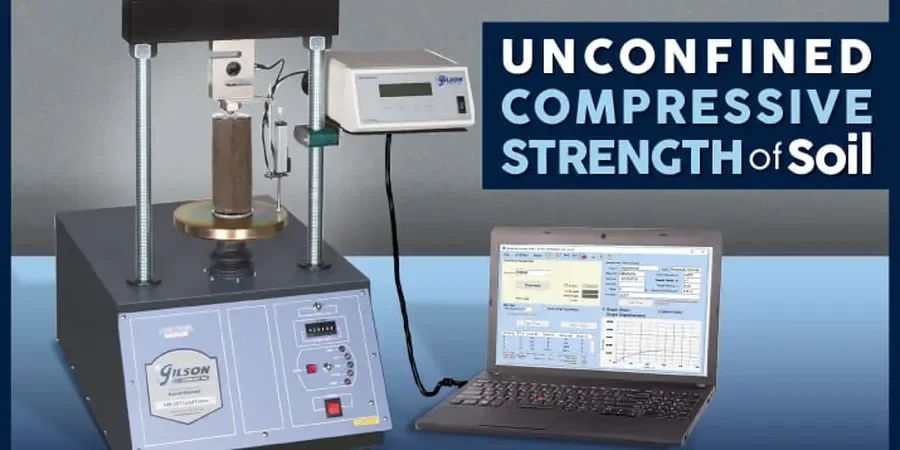
The unconfined compression test measures undrained shear strength directly. One sample, one result. No correction factors needed.
Scope of work
Area-specific notes
Charlotte sits on the Piedmont plateau. That means deep saprolite over weathered rock. The clay fraction often contains kaolinite and mica. Those minerals give the soil a deceptive appearance. We have seen projects where the same unconfined compression test yielded 0.8 ksf in wet season and 2.5 ksf in dry season. The risk is real. If you test only during drought, you overestimate strength. Our lab runs UCS on samples at their in-situ moisture content. We also test after saturation to simulate worst-case conditions. That second value tells you what happens after a hurricane or prolonged rain. For slopes, that difference can mean the line between stable and failed.
Watch how it works
Standards used
ASTM D2166-16, IBC 2018 Chapter 18, ASCE 7-16 Section 11.4, AASHTO T-208
Linked services
Standard UCS on Shelby Tube Samples
We receive 3-inch or 2-inch Shelby tube samples from your drill rig. We extrude, trim, and test them per ASTM D2166. Report includes stress-strain curve, peak UCS, failure strain, and moisture content. Typical turnaround is 3-5 business days.
UCS on Block Samples from Test Pits
For shallow foundations or pavement subgrade, we take block samples from test pits. We trim them in the lab to standard dimensions. This method preserves soil fabric better than tubes. Ideal for stiff fissured clays common in Charlotte.
Typical parameters
Top questions
How much does an unconfined compression test cost in Charlotte?
The typical range is between US$300 and US$540 per test. Price depends on sample size, number of tests, and whether you need saturation testing. Volume discounts apply for 10 or more samples.
What is the difference between UCS and triaxial test?
UCS applies zero confining pressure. Triaxial tests apply lateral stress. UCS is faster and cheaper. It works for saturated clays where undrained strength is the design parameter. Triaxial is better when you need effective stress parameters or when the soil is partially saturated.
Can UCS be used for slope stability analysis?
Yes, but only for short-term undrained conditions. For long-term drained stability, you need effective stress strength from triaxial tests. In Charlotte, slopes in residual clay often fail during heavy rain. UCS gives you the undrained strength for that scenario. We recommend combining UCS with stability analysis using effective stress parameters for a complete picture.
How long does it take to get UCS results?
Standard turnaround is 3 to 5 business days after sample receipt. Rush service is available in 24 hours for an additional fee. The test itself takes 15-30 minutes per sample. Most of the time goes to trimming, documentation, and curing if saturation is needed.