Charlotte's Piedmont geology presents a real challenge for builders. The residual soils from weathered granite and gneiss can vary from stiff to plastic clay within meters. Many projects here hit soft clay pockets or high-plasticity zones that make standard compaction useless. That is where lime and cement stabilization becomes the practical fix. We treat the soil in place, dry it, reduce its plasticity, and create a stable working platform. Before starting a stabilization job, we often run a plate load test to verify the existing subgrade modulus and a CBR test to determine the soaked strength of the treated layer. This approach saves weeks of over-excavation and import costs on Charlotte sites.
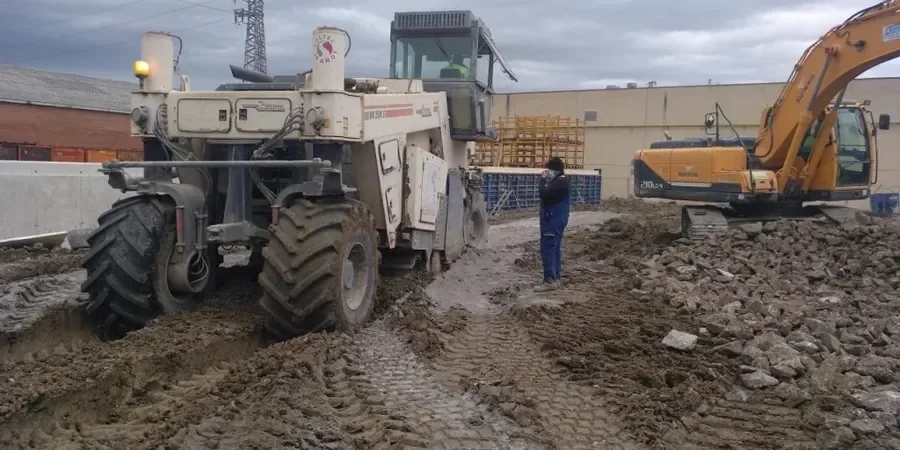
Lime and cement stabilization can cut construction schedules by 30% compared to full over-excavation in Charlotte's residual clay.
Scope of work
Area-specific notes
Charlotte sits in a moderate seismic zone per ASCE 7, with a peak ground acceleration of about 0.10 g for a 2% exceedance in 50 years. While large earthquakes are rare, the Piedmont soils can amplify shaking in deeper residual profiles. The bigger risk here is volumetric change. High-plasticity clays in Charlotte's saprolite can swell and shrink dramatically with moisture. If a treated layer is not properly designed, it can crack under shrinkage or lose strength in wet conditions. We address this by running swell tests on the proposed mix design and by verifying the unconfined compressive strength after 7 days of curing. A well-designed stabilization job eliminates these risks before the first truck rolls in.
Standards used
ASTM C977 – Standard Specification for Quicklime for Soil Stabilization, ASTM C150 – Standard Specification for Portland Cement, ASTM D4318 – Standard Test Methods for Liquid Limit, Plastic Limit, and Plasticity Index of Soils, ASTM D1883 – Standard Test Method for California Bearing Ratio (CBR) of Laboratory-Compacted Soils, ASTM D1633 – Standard Test Methods for Compressive Strength of Molded Soil-Cement Cylinders
Linked services
Lime Stabilization for Plastic Clays
For high-PI clays common in Charlotte's saprolite, we apply quicklime or hydrated lime at dosages from 3% to 8%. The lime reacts with clay minerals to reduce plasticity, improve workability, and increase strength over 7 to 14 days. We verify the design with Atterberg limits and unconfined compression tests on laboratory-mixed specimens.
Cement Stabilization for Low to Moderate Plasticity Soils
When soils have a PI below 20 or when early strength gain is critical, we use Portland cement at 2% to 6% by dry weight. Cement hydration binds soil particles into a rigid matrix, achieving 7-day compressive strengths of 150 to 400 psi. This is ideal for subgrades under pavements and building slabs in Charlotte.
Typical parameters
Top questions
What is the typical cost range for lime and cement stabilization in Charlotte?
For a standard treatment on a building pad or road subgrade in Charlotte, costs typically range from US$770 to US$2,700 per project, depending on the area treated, depth of stabilization, dosage rates, and whether lime, cement, or a combination is used. The final price is determined after lab mix design and site conditions are evaluated.
How long does the stabilization process take on a Charlotte site?
The whole process usually takes 3 to 7 days per lift. Lime mellowing lasts 24 to 72 hours, followed by cement mixing and compaction. Curing before traffic loads can add 7 to 14 days. For large pads, we sequence the work so that one section cures while another is being mixed.
Can stabilization work on all soil types in Charlotte?
It works best on fine-grained soils with a plasticity index above 10. Sandy or gravelly soils with low fines content do not benefit much from lime. For those, mechanical compaction or cement stabilization is more effective. We always run a preliminary laboratory evaluation on a representative sample to confirm suitability.
What testing is required before starting stabilization?
We need a representative soil sample to perform Atterberg limits, natural moisture content, grain size analysis, and a Proctor compaction test. From that we design the lime or cement dosage. We then run a CBR test and unconfined compression test on the treated specimens to verify that the design meets project specifications.
Do you handle the application in the field as well?
Yes. Our team can supervise or perform the full field application: spreading the binder, mixing to the required depth, moisture control during mellowing, and final compaction. We also do quality control testing during construction, including density checks and in-place strength verification.