Many builders in Charlotte assume the reddish clay they dig into is uniform. That assumption often leads to differential settlement and cracked slabs within two years. Residual soils derived from the Piedmont bedrock — mica schist, gneiss, and granite — can vary from stiff crust to soft, weathered rock in just a few feet. Without proper residual soil characterization, foundation loads get designed for the wrong layer. That is why teams here combine test pits with a compression test on intact samples to confirm bearing capacity before pouring footings. The cost of fixing a settled foundation far exceeds the upfront investigation.
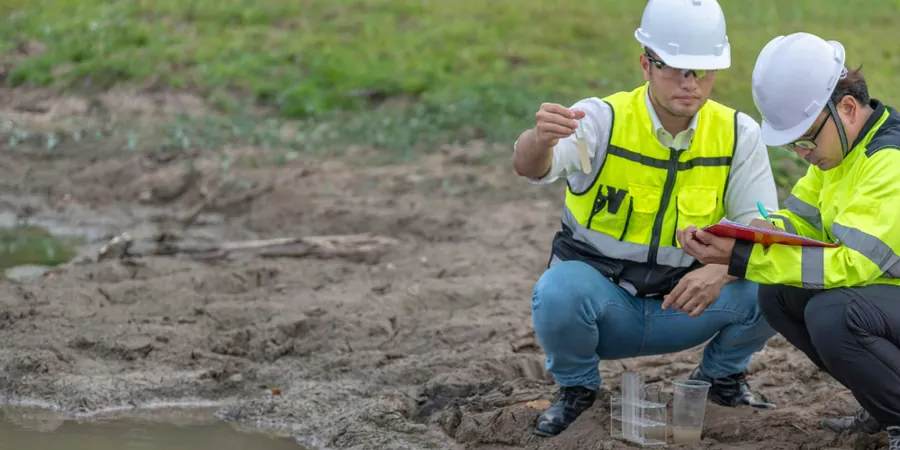
Residual soils in Charlotte’s Piedmont can grade from stiff clay to soft rock in under three feet — classification alone is not enough.
Scope of work
Area-specific notes
A common mistake is treating residual soils in Dilworth the same as those in University City. The mica content and degree of weathering vary block by block. In some Charlotte neighborhoods, construction on untreated saprolite has triggered slow, progressive settlement that cracks masonry walls years later. Ignoring the relict joint structure in the soil can also lead to unexpected seepage paths during basement excavation — especially near the Sugar Creek watershed. Residual soil characterization identifies these risks before concrete is poured, giving the design team data to decide whether shallow footings or deep foundations are needed for each specific lot.
Standards used
ASTM D1586-18 (SPT in residual profiles), ASTM D2487-17 (Unified Soil Classification System), IBC 2021 Chapter 18 (foundation design on weathered rock), ASCE 7-22 (site class determination for seismic loads)
Linked services
Test Pit Excavation & Logging
Machine-excavated pits to 15 ft depth, logged by a certified geologist. We record weathering grade, color, moisture, and relict structure. Bulk and undisturbed samples are taken for lab classification. Useful for shallow foundations and utility corridors.
SPT Borings with Shelby Tube Sampling
Standard Penetration Tests at 5-ft intervals with continuous split-spoon sampling. Thin-walled Shelby tubes retrieve undisturbed specimens for triaxial and consolidation tests. Ideal for multi-story buildings requiring bearing capacity verification in saprolite.
Typical parameters
Top questions
What makes residual soil characterization different from standard soil testing?
Residual soils retain fabric and structure from the parent rock. Standard classification alone (color, plasticity) can misrepresent strength. Characterization includes weathering grade assessment, relict joint mapping, and anisotropic strength testing — essential for Piedmont geology in Charlotte.
How deep do we need to investigate residual soils in Charlotte?
Depends on the building load and weathering profile. For typical residential slabs, test pits to 10-12 ft are common. For commercial structures, SPT borings to 30-40 ft may be needed to reach competent rock or to define the full saprolite thickness.
Can residual soils in Charlotte cause seismic design issues?
Yes. The National Earthquake Hazards Reduction Program (NEHRP) site class depends on average shear-wave velocity in the top 100 ft. Deep, loose saprolite can lower the site class, increasing seismic design forces. We use MASW or Vs30 methods to classify the profile per ASCE 7.
What is the typical cost range for residual soil characterization in Charlotte?
A basic program (2 test pits + lab classification) runs between US$960 and US$3.550, depending on depth, number of samples, and required turnaround. More extensive SPT programs with triaxial tests fall at the higher end of that range.
How long does the characterization process take?
Fieldwork usually takes 1-2 days for a typical lot. Lab testing (classification, strength, consolidation) adds another 5-10 business days. Rush schedules are possible with priority processing, but the full picture requires curing time for some tests.