We worked on a site near the Catawba River where the client was building a new warehouse distribution center. The native soil was a thick deposit of Piedmont residual clay with high plasticity and low permeability. Without intervention, primary consolidation would take years under the proposed 6-foot fill. That project needed a reliable prefabricated vertical drain (PVD) design to accelerate settlement. We ran oedometer tests on undisturbed samples and modeled radial drainage with Smear zone parameters specific to Charlotte clay. The design called for a triangular grid at 1.5-meter spacing to achieve 90 percent consolidation in four months instead of three years. We also coordinated with the contractor to install a surcharge load and monitor piezometers during the wait period. For similar projects, we often combine PVD design with a dilatometer test to estimate lateral stress conditions before finalizing drain spacing.
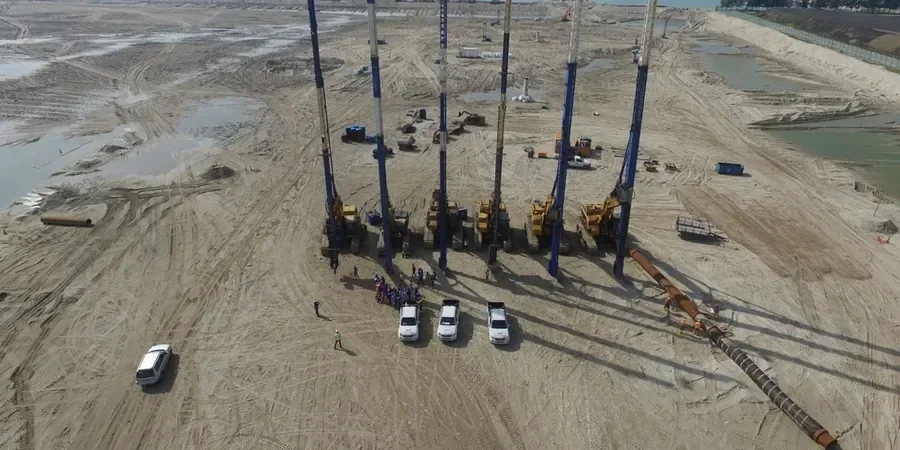
A properly designed PVD grid can cut consolidation time from years to months in Charlotte's low-permeability Piedmont clays, reducing project delays and foundation risk.
Scope of work
- Discharge capacity at site-specific confining pressure
- Smear zone permeability reduction ratio
- Time to target consolidation under design load
- Equivalent drain diameter and well resistance
Area-specific notes
Charlotte lies in the Piedmont physiographic province where residual soils are highly weathered and often contain corestones or saprolite layers that can obstruct drain installation. If the mandrel hits a hard layer or partially weathered rock, the drain may buckle or tear, reducing its discharge capacity. We always review the boring logs for refusal zones before finalizing the PVD depth. Another risk is clogging of the filter by fine particles migrating from the clay matrix during consolidation. We mitigate this by specifying a filter with a smaller opening size (O95 < 100 µm) and by running gradient ratio tests on site-specific soil. The design must also account for potential lateral displacement under the surcharge load, especially near slope edges or buried utilities.
Standards used
ASTM D2435 (one-dimensional consolidation), ASTM D1586 (Standard Penetration Test), ASCE 7-22 (Minimum design loads for buildings), IBC 2021 (International Building Code, Chapter 18)
Linked services
Consolidation Testing & Modeling
Oedometer tests with radial drainage simulation. We determine Cv, Cr, Cc, and coefficient of radial consolidation (Cr) from undisturbed samples. Results feed directly into your PVD spacing calculation.
Installation Supervision & QA/QC
On-site monitoring of mandrel penetration, drain alignment, and splice integrity. We verify discharge capacity and filter integrity per manufacturer specs. Includes daily reports and as-built records.
Settlement Monitoring & Verification
Piezometers, settlement plates, and inclinometers installed before surcharge. Data collected weekly during consolidation period. We compare actual settlement to predicted curves and adjust timeline if needed.
Typical parameters
Top questions
What is the typical cost range for a PVD design study in Charlotte?
A complete prefabricated vertical drain design study in Charlotte, including field sampling, consolidation testing, and modeling, typically ranges from US$960 to US$2.690. The final cost depends on the number of boreholes, sample depth, and whether installation supervision is included.
How long does consolidation take with PVDs compared to without?
Without drains, primary consolidation in Charlotte's Piedmont clay can take 3 to 10 years for a 6-foot fill. With a properly designed PVD grid at 1.5-meter spacing, we routinely achieve 90 percent consolidation in 3 to 6 months. The exact time depends on drain spacing, surcharge magnitude, and soil layering.
Can PVDs be installed in Charlotte's saprolite or partially weathered rock?
PVDs are designed for soft to firm cohesive soils, not hard saprolite or rock. If boring logs show refusal within the target depth, we recommend a hybrid approach: deeper drains through the soft clay followed by rock removal or alternative Improvement like deep soil mixing. We always review the logs before finalizing the design.