Charlotte sits at about 750 feet above sea level on the edge of the Piedmont region, where residual soils derived from weathered granite and gneiss can vary dramatically over short distances. In our experience, this variability makes the field permeability test a critical tool for projects involving deep foundations, retaining walls, or stormwater infiltration systems. When we measure hydraulic conductivity directly in the borehole using the Lefranc or Lugeon method, we get real data on how water moves through the saprolite and fractured bedrock — far more reliable than lab estimates on disturbed samples. For example, on a recent mixed-use development near Uptown, the Lugeon test revealed zones of high permeability that would have compromised the planned infiltration gallery, saving the owner from an expensive redesign. We typically pair this test with laboratory permeability tests on undisturbed cores to cross-check anisotropy, and with subsurface exploration via test pits to calibrate our stratigraphic model.
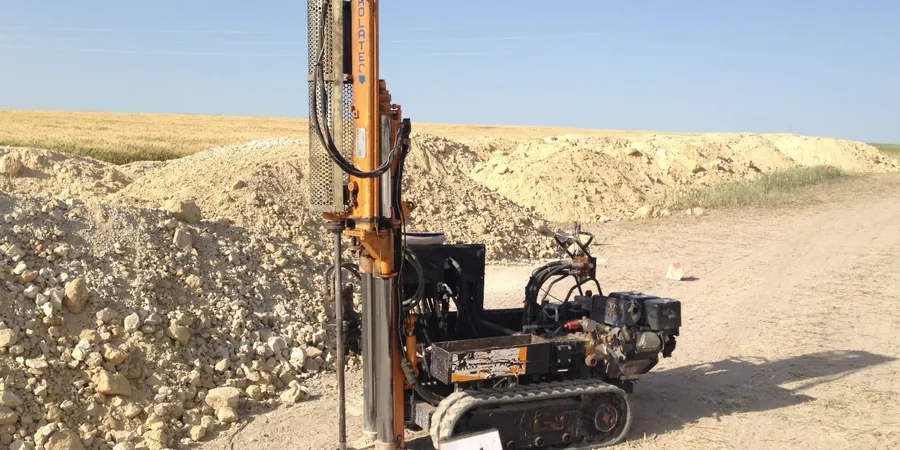
A single Lugeon test in fractured gneiss can reveal a hidden seepage path that no lab test on a sample will ever find.
Scope of work
- Constant-head (Lefranc) for soils and saprolite, with test durations of 30–90 minutes per stage to reach steady-state.
- Packer-based Lugeon tests in rock, applying five pressure stages (up to 10 bars) to detect hydrofracturing or joint dilation.
- Field log of water level recovery between stages to estimate storativity.
Area-specific notes
The Piedmont saprolite in Charlotte often exhibits a shallow groundwater table — sometimes within 10 to 15 feet of the surface during wet seasons — combined with clayey residual soils that can mask open fractures in the underlying rock. If a contractor assumes uniform low permeability everywhere, they risk catastrophic under-design of dewatering systems or over-excavation for foundations. We have seen cases where a standard SPT program alone missed a fractured zone that later caused a retaining wall to lean during excavation; a Lugeon test in that same borehole would have flagged the issue at the investigation stage. Applying the field permeability test at the right borehole intervals clarifies where grouting, drainage, or cutoff walls are actually needed.
Standards used
ASTM D5092, USBR 7310, IBC Section 1803
Linked services
Lefranc Permeability Test (Constant-Head)
Best suited for the shallow saprolite and residual soils common in Charlotte. We install a slotted casing or screened section at the test depth, then maintain a constant water level while measuring inflow rate. Results are directly applicable to foundation drainage design, infiltration basin sizing, and slope stability analysis. Our field team uses electronic pressure transducers for precise flow measurement, and we report K values with confidence intervals.
Lugeon Packer Test (Multi-Stage)
Designed for the fractured gneiss and schist bedrock underlying much of Charlotte. A single or double packer isolates a test interval, and water is injected at up to five ascending pressure stages. We record flow at each stage to compute the Lugeon value and identify hydrofracturing behavior. This is essential for deep foundations, tieback anchors, and grouting programs where rock mass permeability governs performance.
Typical parameters
Top questions
How much does a field permeability test (Lefranc/Lugeon) cost in Charlotte?
For a standard test with one packer setup and up to five pressure stages, you can expect a range between US$600 and US$1,080 per test interval, depending on depth, access conditions, and the number of test stages required. We recommend contacting us with your borehole logs for a firm quote.
When should I use Lefranc vs. Lugeon for my Charlotte project?
Use the Lefranc constant-head test in soil or saprolite above the weathered bedrock — typically down to 30-50 feet in Charlotte. Use the Lugeon packer test when you need to characterize permeability in the fractured gneiss or schist bedrock, especially if you are designing dewatering for a deep excavation or grouting for a dam. The Lugeon method is also better at detecting pressure-dependent behavior like joint opening.
How many field permeability tests do I need for a typical site in Charlotte?
For a 5-acre commercial site, we usually recommend at least one test per distinct geologic unit, with a minimum of three tests distributed across the property. If the site has variable topography or known fracture zones — common near streams in Charlotte — you may need up to six tests to capture the range of permeability. The IBC requires site-specific permeability data for stormwater infiltration design, so your geotechnical engineer should include this in the scope.