Charlotte grew fast over the last two decades, pushing development into former farmland and wooded hillsides. The underlying Piedmont geology — deep saprolite, weathered gneiss, and variable schist — means bearing capacity can change within meters. A plate load test (PLT) gives a direct measurement of soil response under load, not a correlation. Before finalizing a shallow foundation design, engineers often cross-check PLT results with a calicata exploratory to visually confirm the bearing stratum, or run SPT borings for a profile of strength with depth. That combination reduces guesswork in a city where the transition from residual soil to rock is rarely uniform.
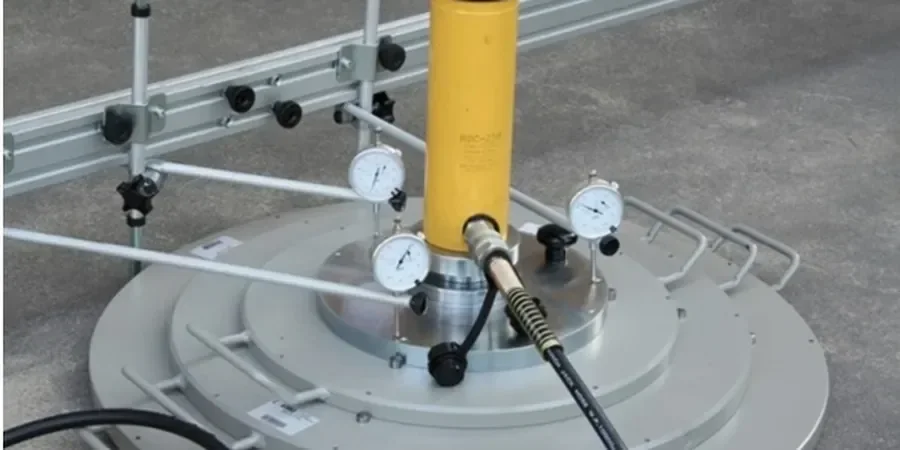
A plate load test measures actual soil response under load — not a correlation — which matters where saprolite transitions into hard rock within a single lot.
Scope of work
Area-specific notes
IBC 2021 and ASCE 7 require site-specific foundation design for any building in a Seismic Design Category B or higher — most of Charlotte falls in C or D. A plate load test (PLT) alone does not address liquefaction or cyclic softening, but it provides the baseline stiffness for settlement-controlled design. The bigger risk in Charlotte is shallow fill placement on residual soil without verifying density. A PLT run directly on the prepared subgrade reveals whether the modulus meets the structural engineer's assumption. Skipping this test often leads to differential settlement claims within the first year, especially on the clay-rich B-horizon common in Mecklenburg County.
Standards used
ASTM D1196-12 (Standard Test Method for Nonrepetitive Static Plate Load Tests), ASTM D1194 (Repetitive Static Plate Load Tests), IBC 2021 Section 1806 (Bearing Capacity of Soils)
Linked services
Static PLT – Single- and Multi-Cycle
Standard nonrepetitive test per ASTM D1196 for bearing capacity and modulus. Multi-cycle option available for cyclic loading simulations on paved areas or crane pads.
Rapid Plate Load Test (Dynamic PLT)
Falling weight deflectometer (FWD) equivalent for compaction control on subgrade and base courses. Results correlate to static moduli via empirical factors calibrated for Piedmont soils.
Typical parameters
Top questions
What is the difference between a plate load test and a CBR test?
Both measure bearing capacity, but the plate load test applies a larger plate (300–762 mm) at the actual foundation depth under static load, while CBR is a laboratory puncture test on remolded or undisturbed samples at a fixed penetration rate. PLT gives a direct field modulus; CBR is an index for pavement design.
How many plate load tests are recommended for a typical Charlotte commercial lot?
For a uniform site underlain by residual soil, one test per distinct soil zone is adequate. On a 2-hectare lot with variable topography, we recommend at least three tests — one on each cut, fill, and natural grade area. The geotechnical engineer should define the test locations based on the SPT and classification data.
Can a plate load test detect loose fill or soft spots in the subgrade?
Yes. A low modulus value relative to the surrounding area indicates a soft zone. We recommend testing at 2–3 points per 1000 m² if fill thickness exceeds 1 m. The test is sensitive enough to detect a 0.5 m deep loose pocket, which would then require excavation and recompaction.
What is the typical cost of a plate load test in Charlotte?
The standard range is US$740 to US$1,420 per test point, including mobilization, plate setup, loading, data recording, and a one-page summary report. Costs increase for multi-cycle tests, remote access, or after-hours work. A full investigation with three points plus SPT borings runs between US$2,800 and US$4,500.