The transition from the deep, decomposed saprolite of Myers Park to the stiff residual clays of Dilworth reveals why Charlotte demands a tailored approach to Improvement. Foundation loads that perform well on one corner of town can encounter very different settlement responses just a few miles away. Stone column design in Charlotte addresses this variability by installing granular columns to reinforce soft zones, accelerate consolidation, and reduce total and differential settlements. The technique works by replacing a percentage of the weak native soil with compacted stone, creating a composite ground with higher stiffness and improved drainage. For multi-story buildings or large storage tanks, this solution often proves more cost-effective than deep foundations, particularly when the problematic layer is 15 to 25 feet thick.
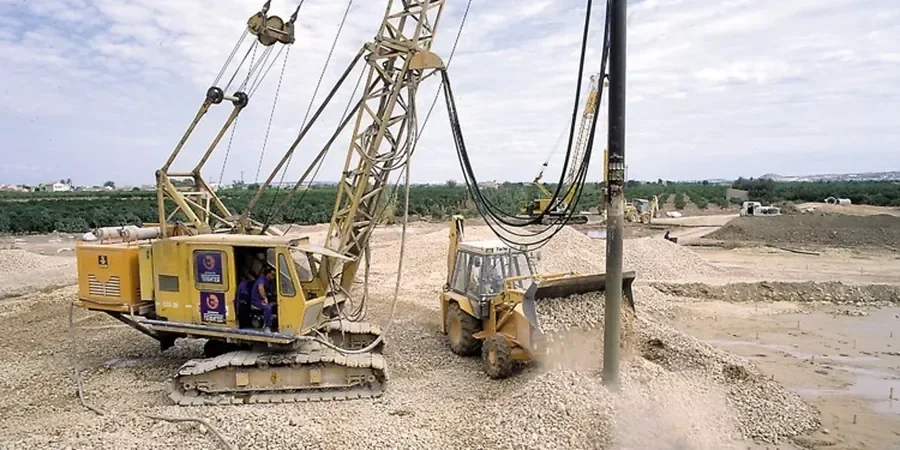
A well-designed stone column grid can reduce total settlements by 50 to 70 percent compared to untreated ground, provided the stone gradation and compaction method match the local soil conditions.
Scope of work
Area-specific notes
In Charlotte, one recurring issue is the presence of organic-rich zones within the saprolite, particularly near historic stream channels that are now buried under fill. These soft inclusions can go undetected if borings are spaced too widely. Stone column design in Charlotte must therefore incorporate a minimum of one CPT sounding per 1,000 square feet of footprint to map these weak pockets. Another risk is column bulging in very soft clays (Su < 25 kPa), which can be mitigated by using a geotextile encasement or by increasing column diameter in the upper portion. The team always verifies the stone aggregate source for durability and angularity, as rounded river gravels from local quarries may not interlock properly under high lateral stress.
Standards used
ASCE 7-22 Minimum Design Loads and Associated Criteria for Buildings and Other Structures (settlement criteria), IBC 2021 Chapter 18 – Soils and Foundations, FHWA Geotechnical Engineering Circular No. 13 (Stone Column Design Guidelines), ASTM D1586-18 Standard Test Method for Standard Penetration Test (SPT)
Linked services
CPT Soundings with Pore Pressure Measurement
Continuous piezocone penetration tests provide high-resolution profiles of tip resistance, sleeve friction, and pore pressure, allowing precise identification of soft layers and estimation of consolidation coefficients for column spacing optimization.
Triaxial Testing (CU and UU)
Consolidated-undrained and unconsolidated-undrained triaxial tests on undisturbed samples define the undrained shear strength and stress-strain behavior of the residual clays, critical for calculating the lateral confinement required by the stone columns.
Plate Load Testing on Stone Columns
In-situ plate load tests (up to 0.3 m diameter) on trial columns verify the composite modulus and confirm that the design assumptions for settlement control are met before production columns are installed.
Typical parameters
Top questions
What is the typical cost range for stone column design in Charlotte?
The cost for stone column design in Charlotte typically falls between US$1,280 and US$4,700, depending on the number of CPT soundings, the complexity of the soil profile, and the need for triaxial or plate load testing. This range includes field investigation, lab testing, and the design report.
How deep should stone columns extend into the saprolite in Charlotte?
Stone columns should extend through the soft upper clay into the stiffer saprolite layer, typically reaching a depth where SPT N-values exceed 15 blows per foot. In most Charlotte sites, this means column lengths between 15 and 30 feet, depending on the thickness of the compressible zone.
Can stone columns be used for liquefaction mitigation in Charlotte?
Charlotte is not in a high-seismic zone (ASCE 7 Site Class C or D), but stone columns can still improve drainage and reduce liquefaction potential in loose saturated sands if present. The design would follow NCEER (Youd-Idriss 2001) procedures, and the columns would be spaced to achieve a post-treatment SPT N-value above 30.
What is the difference between stone columns and deep soil mixing for Charlotte soils?
Stone columns rely on granular material and compaction to improve drainage and bearing capacity, while deep soil mixing uses cementitious binders to create stiff columns. For Charlotte's residual clays with low permeability, stone columns are often preferred because they accelerate consolidation without altering the natural soil chemistry, and they can be installed with less equipment mobilization.