In Charlotte, many road projects hit the same snag: the native Piedmont saprolite looks solid when dry but turns into a sticky mess once water seeps in. We routinely find that the residual soils from weathered granite and gneiss have plasticity indices ranging from 15 to 30, which means they swell and shrink enough to crack a pavement base within two seasons. That is why soil stabilization for roads becomes a practical necessity here, not just a technical checkbox. Before any lime or cement treatment begins, we run a full set of classification tests, including a grain size analysis to confirm the fines content, because the dosage of additive depends heavily on how much silt and clay the borrow material actually holds.
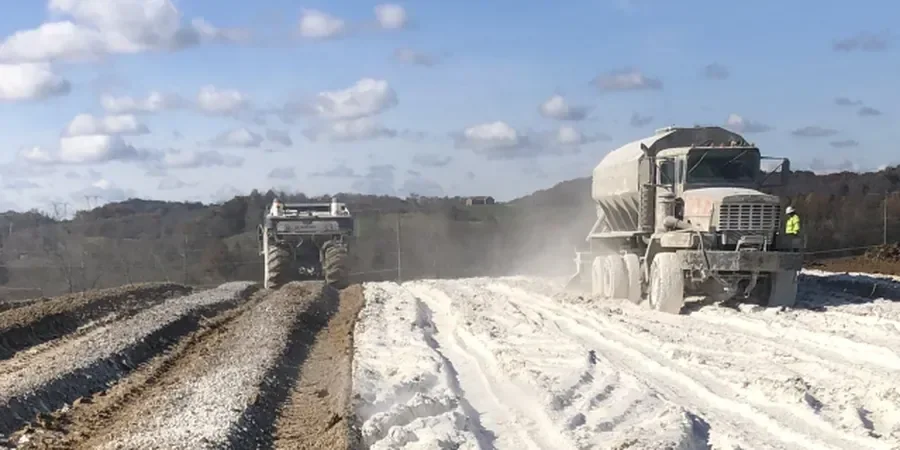
Treating the Piedmont saprolite with 3% lime can cut its plasticity index by half, preventing the subgrade from pumping under heavy truck loads.
Scope of work
Area-specific notes
A common mistake that Charlotte contractors make is skipping the plasticity verification of the borrow material and assuming all Piedmont soils respond the same way to lime. We have seen cases where a contractor applied 4 percent cement to a section that actually contained high mica content, and the treated layer lost strength after two wet-dry cycles. The real risk is differential pavement movement: if one lane gets stabilized properly and the adjacent lane does not, the joint develops a longitudinal crack that lets water into the base. That is why we recommend running a full characterization before any stabilization work, including a determination of the Atterberg limits on every source of fill.
Standards used
ASTM D4318 (Atterberg Limits), ASTM D698 (Standard Proctor), AASHTO T-88 (Particle Size Analysis), IBC Chapter 18 (Excavation and Fill)
Linked services
Subgrade investigation and classification
We drill test pits and collect undisturbed samples to determine the natural moisture content, density, and Atterberg limits of the existing subgrade. The data is used to calculate the required lime or cement dosage and to verify that the treated layer meets the project's CBR specification.
Stabilization mix design and field verification
Our lab prepares a mix design with the exact stabilizer percentage and curing protocol for your specific borrow source. During construction, we perform density tests with a nuclear gauge and take grab samples for unconfined compression to confirm that the field results match the design assumptions.
Typical parameters
Top questions
Why is soil stabilization for roads necessary in Charlotte?
Charlotte's Piedmont soils have high plasticity and shrink-swell potential. Without treatment, the subgrade loses strength when wet, leading to pavement rutting and cracking within a few years. Stabilization with lime or cement reduces plasticity and increases load-bearing capacity.
What is the typical cost range for this service in Charlotte?
The cost for a stabilization mix design and field verification in Charlotte typically ranges from US$810 to US$3,010 per project, depending on the number of borrow sources, the depth of treatment, and the complexity of the traffic control plan.
How long does the curing period take before traffic can use the road?
For lime-stabilized subgrade, we recommend a minimum curing period of 48 hours at temperatures above 60°F. Cement-treated sections can open to traffic after 24 hours if the moisture content is below optimum and the density exceeds 95 percent of the Proctor maximum.
Can stabilization fix existing pavement failures on older Charlotte roads?
Yes. Full-depth reclamation with lime or cement is a common technique for rehabilitating failed asphalt roads. The existing pavement and base are pulverized, mixed with stabilizer, and recompacted to form a new, stronger base layer that can be overlaid with fresh asphalt.