Anyone who has built in Charlotte knows the ground doesn't give up its secrets easily. The Piedmont region's deep saprolite layers, weathered from crystalline rock, create a velocity profile that standard borings alone can miss. That is where the HVSR microtremor survey (Nakamura method) becomes a practical tool for local geotechnical work. Instead of deploying an active source or drilling through 30 feet of decomposed granite, the team sets a compact three-component seismometer on the surface and records ambient vibrations for 30 to 60 minutes. The horizontal-to-vertical spectral ratio reveals the fundamental resonance frequency of the soil column. For a 10-story building planned near Uptown, knowing that frequency early helps avoid costly surprises in foundation design. The method works particularly well on Charlotte's saprolitic soils because the strong impedance contrast between weathered material and fresh bedrock produces a clear H/V peak.
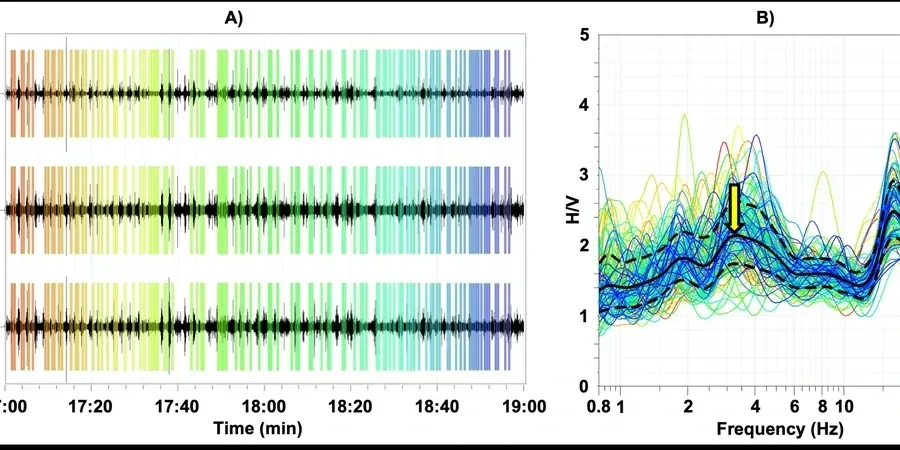
The H/V peak from Charlotte saprolite is often so clear that 40 minutes of recording replaces a full day of active seismic line setup.
Scope of work
- Frequency range typically 0.5 to 20 Hz, covering most engineered structures.
- Deployment time under one hour per station; multiple stations cover a site in a single day.
- No permits needed for passive recording, unlike active seismic or drilling in protected zones.
- Results correlate directly with VS30 estimates for seismic site class per ASCE 7-22.
Area-specific notes
Charlotte's urban expansion over the past two decades has pushed development onto former farmland and hillsides with variable saprolite thickness. A building in South End may sit on 30 feet of weathered granite while a block away the bedrock rises to within 8 feet. The risk of differential resonance between adjacent structures — especially in townhome clusters — is real. An HVSR microtremor survey at the planning stage flags those contrasts before foundation contracts are signed. Without it, two adjacent units could experience significantly different seismic amplification during a moderate Piedmont earthquake, leading to non-structural damage that is expensive to repair.
Standards used
ASCE 7-22 (Seismic Site Classification), IBC 2021 (Chapter 16 – Site Characteristics), SESAME 2004 (Site Effects Assessment Using Ambient Excitations)
Linked services
MASW / VS30 Profiling
Active multichannel analysis of surface waves for 1D shear-wave velocity profiles. When combined with HVSR, the passive resonance peak anchors the deeper velocity structure. Useful for NEHRP site class confirmation on large lots.
Refraction Microtremor (ReMi)
Linear array recording of ambient noise to extract dispersion curves down to 100+ meters. Particularly effective on Charlotte's thick saprolite where active sources lose energy. Output integrates with HVSR for site response analysis.
Typical parameters
Top questions
What is the HVSR microtremor survey (Nakamura method) and how does it work?
It is a passive seismic technique that uses a single three-component seismometer to record ambient ground vibrations — wind, traffic, microseisms — for 30 to 60 minutes. The horizontal-to-vertical spectral ratio isolates the fundamental resonance frequency of the soil column. In Charlotte's Piedmont geology, the strong impedance contrast between saprolite and bedrock produces a clear peak that correlates with site period and VS30.
How much does an HVSR survey cost for a typical Charlotte project?
For a standard development site with 6 to 10 recording stations, the survey typically falls between US$1,590 and US$2,250. The final cost depends on site access, number of stations, and whether analysis integrates with other geophysical methods. We provide a firm quote after reviewing the site plan.
Do I need HVSR in addition to standard borings for a 4-story building?
Yes, especially in Charlotte where saprolite thickness varies over short distances. Borings give point-specific data. The HVSR microtremor survey fills the gaps between boreholes and identifies areas where the resonance frequency changes abruptly. For IBC seismic site classification, the combination of borings and passive HVSR often eliminates the need for a full VS30 measurement via active methods.