In Charlotte, many pavement failures trace back to the expansive clays of the Piedmont region. A proper existing pavement evaluation starts with core sampling to measure layer thickness and visual distress mapping. We combine this with subgrade exploration via test pits to identify moisture-sensitive soils beneath the asphalt. The goal is clear: determine remaining structural life before designing overlays or full reconstruction. Charlotte's freeze-thaw cycles are mild but the clay shrink-swell potential is real, so we always check the subgrade modulus at field moisture.
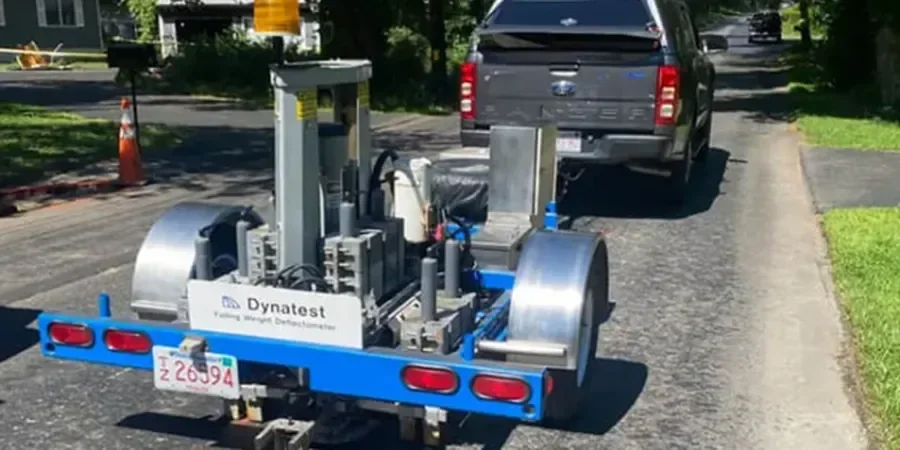
We correlate FWD deflection data with DCP profiles to back-calculate layer moduli for Charlotte's variable Piedmont subgrade conditions.
Scope of work
- Falling weight deflectometer (FWD) testing for deflection basin analysis
- Dynamic cone penetrometer (DCP) profiling for subgrade strength
- Laboratory CBR and resilient modulus (Mr) on undisturbed samples
Area-specific notes
Charlotte's humid subtropical climate drives the biggest risk: moisture intrusion into the subgrade. The Piedmont clay has low permeability when saturated, trapping water under the pavement structure. This reduces the subgrade modulus by up to 50% during wet seasons. Combined with heavy truck traffic on I-85 and I-77 corridors, the result is accelerated fatigue cracking. An existing pavement evaluation that ignores seasonal moisture effects will underestimate overlay thickness. We always core at the edge of wheel paths to capture the worst-case stripping and base contamination.
Watch how it works
Standards used
ASTM D5858-96 (Standard Guide for Calculating In-Situ Equivalent Elastic Moduli of Pavement Materials), AASHTO T-307 (Resilient Modulus of Soils and Aggregate Materials), ASTM D4694-09 (FWD deflection testing), ASTM D6951-18 (DCP in pavement applications)
Linked services
FWD deflection testing and back-calculation
Falling weight deflectometer testing at 50-ft intervals on project sections. We use ELMOD or EVERCALC software to back-calculate layer moduli for overlay design per AASHTO 1993 or MEPDG.
Core sampling and layer thickness verification
Wet-dry diamond coring through asphalt and base layers. We measure thickness, document stripping, and retrieve base material for gradation and plasticity index testing.
Subgrade DCP profiling and CBR correlation
Dynamic cone penetrometer soundings every 200 ft to estimate in-situ CBR and resilient modulus. We correlate with lab CBR on Shelby tube samples from selected locations.
Typical parameters
Top questions
What is the typical cost range for an existing pavement evaluation in Charlotte?
For a standard 2-lane mile project, the cost ranges between US$1,370 and US$3,370 depending on traffic control, number of cores, and FWD test points. Complex sections with variable subgrade may exceed this range.
How many cores are needed per mile of pavement in Charlotte?
We recommend a minimum of 4 cores per lane-mile for rehabilitation projects. In areas with suspected stripping or base contamination, we increase to 6-8 cores to capture variability.
Can FWD testing be done on active roadways?
Yes. We work with Charlotte's traffic control requirements. Testing lanes are closed sequentially using cones and signage. Nighttime testing is available for high-volume corridors like I-485.
What is the difference between DCP and FWD for subgrade evaluation?
FWD measures the structural response of the entire pavement system under a simulated wheel load. DCP profiles only the top 3 ft of subgrade strength. Both are complementary: FWD for layer moduli, DCP for subgrade variability.
How does Charlotte's clay affect pavement evaluation results?
The Piedmont residual clay has high plasticity (PI 20-40) and shrinks/swells with moisture changes. This affects the subgrade modulus by 30-50% seasonally. We account for this by testing at both field and saturated moisture conditions.