Charlotte sits atop a complex mix of residual soils from weathered granite and gneiss, with zones of saprolite that can vary dramatically in bearing capacity over short distances. In our experience, many projects underestimate how much the local Piedmont geology affects pile performance. For shallow depths, we often recommend starting with a standard penetration test to map the transition from weathered rock to competent bearing strata. That data directly informs the pile type and required embedment.
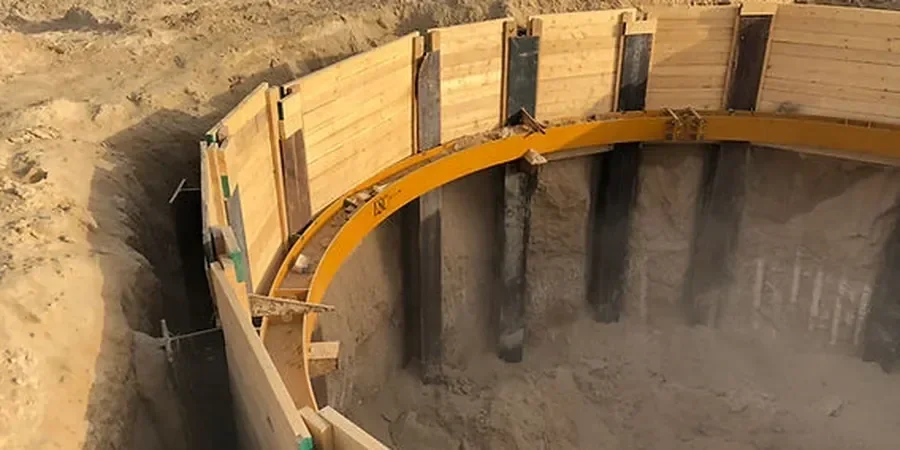
Pile foundation design in Charlotte must account for the erratic weathering of Piedmont bedrock — one borehole alone rarely tells the full story.
Scope of work
- End-bearing resistance in weathered rock layers
- Skin friction in residual clay and saprolite
- Settlement under service loads
- Downdrag potential from soft compressible soils
Area-specific notes
One common mistake we see in Charlotte is relying on a single soil boring to characterize a large site. The Piedmont's irregular bedrock surface can produce a 20-foot difference in depth to refusal within 50 feet. If the pile design ignores that variability, some piles may end up under-designed for lateral loads or end-bearing capacity. We always recommend a phased investigation: initial borings to map the rock profile, then targeted testing where transitions appear.
Standards used
IBC 2021 Chapter 18 (Soils and Foundations), ASCE 7-22 (Minimum Design Loads for Buildings), ASTM D3966 (Standard Test Methods for Deep Foundations Under Static Axial Compressive Load), ACI 543R (Guide to Design, Manufacture, and Installation of Concrete Piles)
Linked services
Pile Type Selection & Design
Analysis of driven piles, drilled shafts, and micropiles based on soil stratigraphy and structural loads. We compare cost, schedule, and vibration constraints for each option.
Bearing Capacity & Settlement Analysis
Using N-values from SPT, rock core data, and laboratory tests to compute ultimate and allowable capacities per IBC and ASCE 7 criteria.
Load Test Supervision & Interpretation
On-site monitoring of static compression, tension, and lateral load tests per ASTM D3966. We provide certified reports for foundation acceptance.
Typical parameters
Top questions
What is the typical cost for pile foundation design in Charlotte?
For a single-family residential project, design fees range between US$1.480 and US$3.500. Commercial or multi-story buildings with multiple load cases can run from US$4.000 to US$6.140. These are rough estimates; the final cost depends on the number of boring locations, testing requirements, and structural complexity.
How deep do piles need to go in Charlotte's soils?
It varies widely. In areas like SouthPark or Ballantyne, weathered rock may be 15 to 30 feet deep, while near Uptown or Dilworth, competent gneiss can be as shallow as 5 to 10 feet. We determine the depth by correlating SPT blow counts and rock core recovery — typically aiming for 10 feet into material with N-values above 50 blows per foot.
What pile type works best for Charlotte's Piedmont geology?
Drilled shafts (caissons) are common in the city because they can be socketed into weathered rock and develop high end-bearing capacity. For sites with shallow rock, driven H-piles or micropiles are efficient. We always consider construction vibration limits, especially near existing structures in dense neighborhoods like Plaza Midwood.