The contrast between Uptown Charlotte's deep residual soils and the shallow bedrock near SouthPark tells two very different stories. In Uptown, thick saprolite overlies weathered granite, while SouthPark sits on gneiss closer to the surface. Seismic tomography resolves these differences by measuring P-wave and S-wave velocities through the ground. A single profile can map the soil-to-rock interface across hundreds of feet. For projects straddling both zones, this method identifies where deep foundations are needed and where shallow spread footings can work. It's the only geophysical technique that provides continuous velocity models rather than point measurements. We combine this with MASW testing to correlate shear-wave velocities with site class definitions. Charlotte's Piedmont geology demands this level of resolution to avoid unexpected rock encounters during excavation.
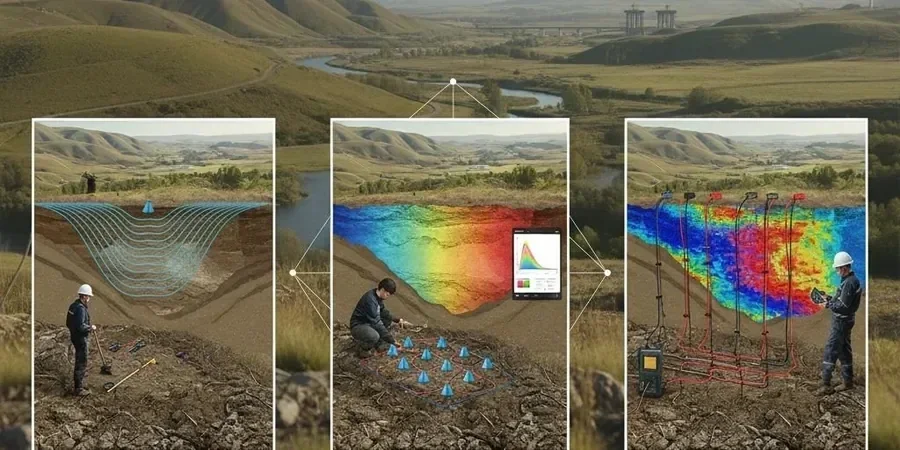
Seismic tomography provides continuous 2D velocity models across Charlotte's Piedmont terrain, revealing soil-to-rock transitions and weathered zones that borings alone cannot map.
Scope of work
Area-specific notes
ASCE 7 site classification in Charlotte depends on average shear-wave velocity in the top 30 meters (Vs30). Without seismic tomography, the site class defaults to C (very dense soil/soft rock) or even D (stiff soil). That assumption can underestimate seismic demand by one class. For a five-story structure in the Uptown area, a shift from Class C to Class D increases base shear by roughly 25 percent. The risk is real: misclassifying a site leads to over-designed foundations or, worse, under-designed lateral systems. Seismic tomography provides the Vs30 profile directly, confirming the site class with field data rather than conservative estimates. It's the most cost-effective way to satisfy IBC Chapter 16 requirements for seismic design in Charlotte.
Standards used
ASTM D5777-18 (Standard Guide for Seismic Refraction), ASCE 7-22 Section 11.4 (Site Classification), IBC 2021 Chapter 16 (Seismic Design Criteria)
Linked services
P-Wave Refraction Tomography
Compressional wave surveys for mapping soil-to-rock interface and weathered zone thickness. Ideal for deep foundation design and excavation planning in Piedmont residuum.
S-Wave Reflection Tomography
Shear wave imaging for identifying stratigraphic interfaces and evaluating small-strain stiffness. Used for seismic site classification and dynamic analysis.
Crosshole Seismic Tomography
Borehole-to-borehole surveys between two or more cased holes. Provides high-resolution velocity profiles for critical structures like bridge piers or high-rises.
MASW with Refraction Integration
Combined multichannel analysis of surface waves and refraction tomography. Delivers Vs30 values and 2D velocity sections in a single field deployment.
Typical parameters
Top questions
What is the difference between refraction and reflection seismic tomography?
Refraction tomography uses first-arrival travel times to build a velocity model of the subsurface. It works best when velocity increases with depth, typical of Charlotte's soil-over-rock profiles. Reflection tomography processes later arrivals to image discrete interfaces like rock fractures or bedding planes. Both methods can be combined in a single survey to maximize resolution across different depth ranges.
How deep does seismic tomography image in Charlotte's Piedmont geology?
Typical surveys reach 10 to 50 meters depth depending on geophone spacing, source energy, and surface conditions. In Charlotte's saprolite, a 48-geophone array with 3-meter spacing resolves the soil-to-rock interface consistently to 25 meters. Deeper targets require longer arrays or borehole sources.
How much does seismic tomography cost in Charlotte?
A standard refraction tomography survey for a 1-acre site costs between US$2,820 and US$4,900. The range depends on line length, number of profiles, and whether reflection processing is included. Crosshole surveys are higher due to drilling and casing costs.
Can seismic tomography replace borings for foundation design?
No. Tomography provides continuous velocity models but does not replace physical samples or SPT data. It is used to optimize boring locations and reduce total drilling footage. A typical approach in Charlotte is to run one or two tomography lines, then place borings at velocity anomalies to confirm soil and rock conditions.