Geophysics in Charlotte plays a critical role in understanding subsurface conditions before construction begins, helping engineers and developers make informed decisions about foundation design, seismic safety, and site suitability. This category encompasses a range of non-invasive investigation techniques that measure physical properties of the ground without extensive excavation, providing essential data for projects ranging from high-rise buildings to infrastructure improvements. In Charlotte's rapidly growing urban landscape, where the Piedmont geology presents unique challenges, geophysical surveys have become an indispensable part of due diligence and risk management.
Charlotte sits within the Piedmont physiographic province, characterized by deeply weathered crystalline bedrock, saprolite formations, and variable soil profiles that can change dramatically over short distances. The underlying geology consists primarily of metamorphic and igneous rocks, including granites, gneisses, and schists, which have undergone millions of years of weathering to create complex subsurface conditions. This weathered rock profile, often extending tens of feet deep, creates significant variability in bearing capacity and stiffness that standard geotechnical borings alone may not fully capture. Consequently, geophysical methods provide the spatial continuity needed to map these transitions accurately.
Regulatory compliance in Charlotte follows the North Carolina State Building Code, which references the International Building Code (IBC) and ASCE 7 standards for seismic site classification. The IBC requires determination of Site Class based on the average shear wave velocity in the upper 30 meters (Vs30), making MASW / VS30 surveys essential for projects seeking to optimize their seismic design category. Additionally, the North Carolina Department of Environmental Quality and local ordinances may require geophysical assessments for landfill investigations, dam safety evaluations, and environmental site characterizations, ensuring that development proceeds with full awareness of subsurface risks.
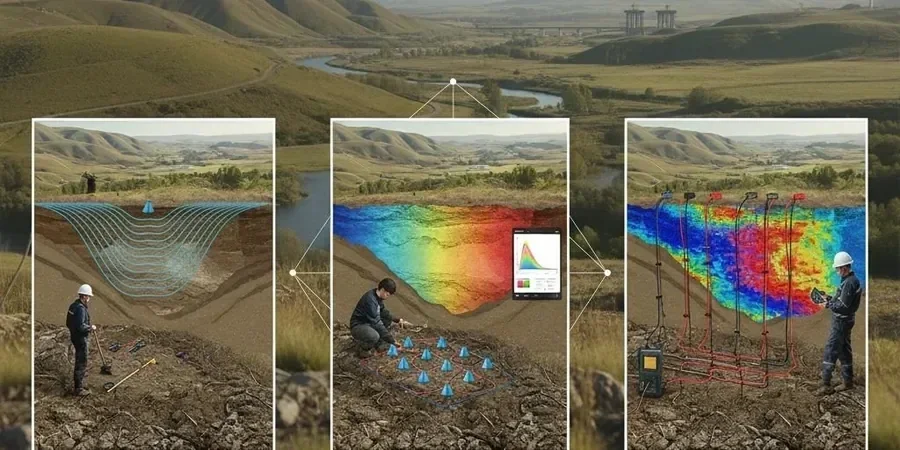
The types of projects that commonly require geophysical investigations in Charlotte include commercial high-rises in Uptown and South End, transportation infrastructure along the I-485 corridor, utility installations, and residential developments on challenging terrain. HVSR microtremor surveys are particularly valuable in urban settings where passive-source techniques can determine site resonance without the need for large equipment or disruptive operations. For projects involving foundation design on variable rock, electrical resistivity testing helps delineate top-of-rock profiles and identify potential solution features or fracture zones. Meanwhile, seismic tomography provides detailed cross-sectional images of subsurface layering, enabling engineers to optimize excavation plans and foundation depths.
Common questions
What is geophysics and how is it applied in Charlotte's construction industry?
Geophysics uses non-invasive surface-based methods to measure subsurface physical properties like seismic velocity, electrical resistivity, and ground stiffness. In Charlotte, these techniques help map weathered rock profiles, determine seismic site class per IBC standards, and locate buried utilities or voids, reducing the need for extensive drilling and providing continuous subsurface information that complements traditional geotechnical borings.
When are geophysical surveys required by building codes in North Carolina?
Under the North Carolina Building Code and referenced IBC/ASCE 7 standards, seismic site classification based on Vs30 measurements is required for most structures in Seismic Design Categories C through F. Geophysical surveys become necessary when sufficient shear wave velocity data from borings is unavailable, or when site conditions suggest high variability that could affect the assigned Site Class and foundation design parameters.
What geological conditions in Charlotte make geophysics particularly important?
Charlotte's Piedmont geology features deeply weathered crystalline bedrock with highly variable saprolite thickness, boulders, and abrupt rock surface changes. These conditions can cause differential settlement and complicate foundation design. Geophysical methods provide lateral continuity that discrete borings cannot, revealing hidden transitions between soil, partially weathered rock, and competent bedrock critical for safe construction.
How do geophysical methods improve project outcomes compared to drilling alone?
Geophysical surveys fill the information gaps between boreholes, revealing subsurface variability that isolated borings might miss. This reduces the risk of encountering unexpected conditions during excavation, optimizes foundation depths and types, and often lowers overall investigation costs by strategically reducing the number of borings needed while providing comprehensive site characterization for engineers and contractors.