Charlotte sits atop a complex mix of Piedmont residual soils—silty sands and micaceous clays derived from weathered granite and gneiss—that can vary dramatically within a single block. The water table often sits 15 to 25 feet deep, but seasonal fluctuations and clay lenses can create perched conditions that catch many developers off guard. A thorough soil mechanics study in Charlotte starts by drilling to refusal or at least to competent saprolite, collecting undisturbed samples for triaxial testing, and running Atterberg limits to classify plasticity. These results feed directly into bearing capacity calculations under ASCE 7 and IBC Chapter 18. In our experience, the biggest surprises come from shallow refusal on unweathered rock or from expansive clays that swell when wet—both are common here. Before finalizing foundation design, many teams also run a dilatometer test to measure lateral stress in residual soils or use MASW surveys to map stiffness profiles across large sites without drilling every corner.
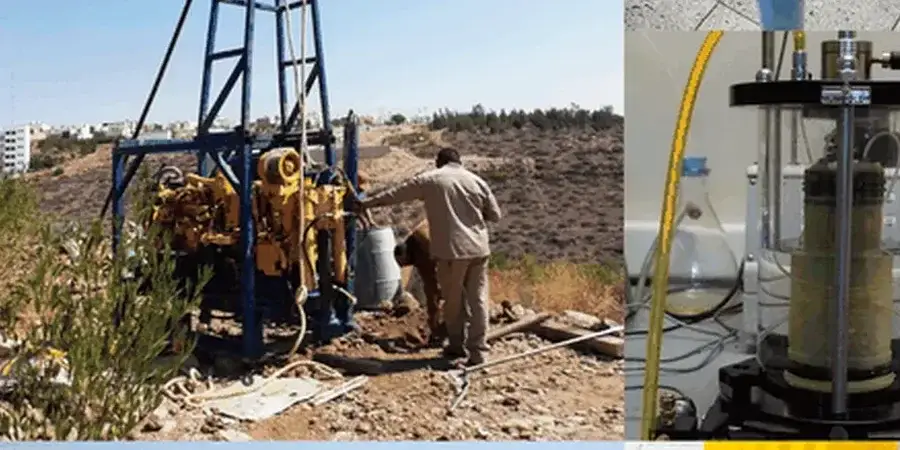
In Charlotte's Piedmont geology, the transition from weathered soil to competent saprolite is the single most critical layer for foundation design.
Scope of work
Area-specific notes
The biggest risk we see in Charlotte is not drilling deep enough. Many residential projects stop at 10 feet because the auger hits refusal, but that refusal might be a boulder or a weathered corestone, not bedrock. If you don't verify with a rock coring bit or a deeper SPT, you could design footings on a false bearing layer that won't hold under heavy rain or seismic loading. The city lies in Seismic Design Category B per IBC, so liquefaction is rare, but differential settlement from variable soil stiffness is a real concern—especially on sloping lots where cut and fill create abrupt changes in subgrade support.
Watch how it works
Standards used
ASTM D1586-18 (Standard Test Method for SPT), ASTM D4318-17 (Atterberg Limits), ASTM D2850-15 (Unconsolidated-Undrained Triaxial), IBC 2021 Chapter 18 (Soils and Foundations), ASCE 7-22 (Minimum Design Loads – Site Class)
Linked services
Standard Residential Soil Mechanics Study
Includes 2 to 4 borings to 25 ft depth, SPT every 5 ft, Atterberg limits, moisture content, and a bearing capacity report per IBC. Suitable for single-family homes, townhouses, and small commercial slabs.
Comprehensive Infrastructure Study
Designed for multi-story buildings, bridges, and road projects. Includes 6+ borings, triaxial CU tests, consolidation testing, slope stability analysis, and a full seismic site classification per ASCE 7. All work done under ISO 17025 quality protocols.
Typical parameters
Top questions
How many borings are needed for a typical home in Charlotte?
Most single-family homes require 2 to 4 borings to 25 ft depth, spaced to cover the footprint and any proposed additions. If the lot has steep slopes or fill areas, we recommend at least one boring per 2,500 sq ft of building area.
What is the difference between a soil mechanics study and a geotechnical report?
A soil mechanics study focuses on the physical and mechanical properties of the soil—strength, compressibility, permeability—while a geotechnical report interprets those results for foundation design. In practice, the study is the lab and field testing phase; the report is the deliverable that includes recommendations.
How deep do we drill in Charlotte's Piedmont soils?
We drill to a minimum of 25 ft or until 3 consecutive SPT blows exceed 50 per foot (refusal). In areas with deep weathering profiles, borings may extend to 40 ft to reach competent saprolite or bedrock. The depth is always confirmed during drilling based on field observations.
How much does a soil mechanics study in Charlotte cost?
For a standard residential study with 3 borings, costs typically range between US$3,420 and US$5,620. Larger commercial projects with 6+ borings and advanced testing can run higher. We provide a fixed quote after reviewing the site plan and structural loads.