Charlotte sits squarely on the Piedmont Plateau, where the top 15 to 25 feet typically consist of residual soils derived from weathered granite and gneiss. Below that, you hit partially weathered rock (PWR) that can vary from soft saprolite to hard rock within a single borehole. That kind of variability is exactly why the Standard Penetration Test (SPT) remains our go-to method for characterizing these heterogeneous profiles. We run it per ASTM D1586-18, recording blow counts every six inches, and the N-value tells us immediately whether we are looking at stiff clay, loose sand, or a boulder that will stop the spoon cold. In our experience, the SPT is the most cost-effective way to get a continuous soil profile when you have no idea what the next five feet will bring. When the project involves shallow foundations, we often pair the SPT with a plate load test to validate bearing capacity directly.
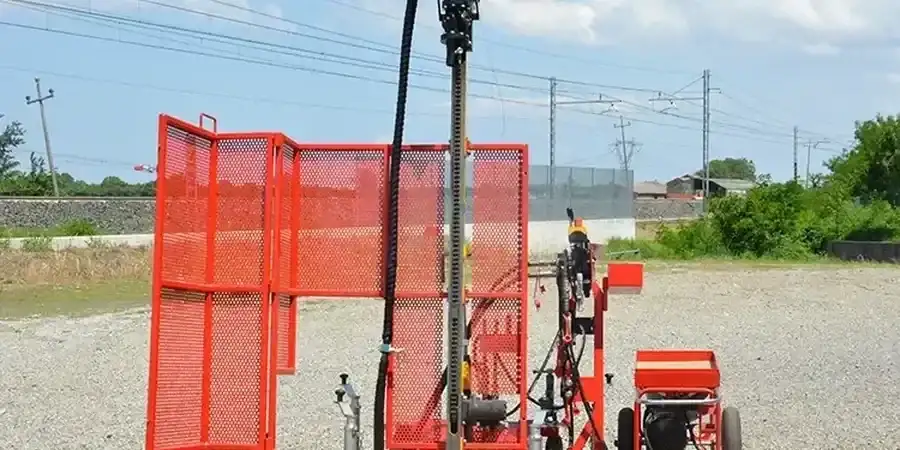
N-values from 8 to 14 in the upper clayey sands and 50+ refusal at 28 feet told us spread footings were viable.
Scope of work
Area-specific notes
Charlotte sits on the eastern edge of the Appalachian seismic zone, where the 1886 Charleston earthquake caused noticeable ground shaking. Modern IBC seismic design categories range from B to C depending on site class, and the SPT N-value is the primary input for determining site class per ASCE 7-22. A site with soft residual soils can amplify ground motions significantly. We have seen projects where ignoring the SPT-based site classification led to underestimating the design spectral acceleration by nearly 30%. That is not a margin you want to gamble with on a 12-story structure. In the Waverly area, we identified a liquefiable sand lens at 18 feet through SPT borings that would have been missed with probing alone.
Standards used
ASTM D1586-18, ASCE 7-22 (Site Class F for soft soils), IBC 2021 Chapter 20
Linked services
Standard SPT Borings (N-Value Profile)
Continuous sampling and blow count logging from surface to refusal. We provide corrected N60 and N1,60 values for liquefaction and settlement analysis.
SPT with Disturbed Sampling
Split-spoon samples retrieved for moisture content, afterberg limits, and grain-size distribution. Samples are sealed and delivered to our lab within 24 hours.
SPT for Seismic Site Class
Boring program designed to meet IBC requirements for site class determination. We calculate average N-value over the top 100 feet for Site Class A through F.
Typical parameters
Top questions
How deep should SPT borings go for a typical Charlotte residential project?
For a two-story house on a slab-on-grade, we recommend boring to at least 15 feet or until refusal in weathered rock. In the Piedmont, the competent layer often appears between 12 and 25 feet, and stopping short can leave you bearing on loose residual soil that settles unevenly.
What is the difference between N-value and corrected N60?
The raw blow count (N) is recorded in the field. N60 applies a correction for hammer efficiency, rod length, and borehole diameter to standardize results across equipment. We always report N60 because it correlates better with relative density and friction angle for design.
How much does an SPT test cost in Charlotte?
A single SPT boring to 25 feet typically runs between US$630 and US$860 depending on access, number of samples, and mobilization. Volume discounts apply for multi-borehole programs.
Can SPT detect boulders or voids in the Piedmont soil?
Yes, a sudden jump in N-value from 10 to 50 plus often indicates a boulder or core stone. We log the depth and refusal condition, and if the boulder is thin, we can attempt to drill through it. SPT does not detect voids directly, but a drop in blow count can suggest a cavity or very soft zone.