In Charlotte, many property owners and engineers discover slope instability only after cracks appear in driveways or retaining walls start leaning — by then, the repair bill is steep. A proper landslide assessment catches these issues early, especially in the Piedmont region where residual soils over weathered bedrock create deceptive stability. We combine field mapping with subsurface exploration to understand exactly what is moving and why. For deeper analysis, we often pair the assessment with a [subsurface investigation using MASW](/masw-vs30/) to measure shear-wave velocity profiles across the site, which helps define the depth of the failure surface. Landslide assessment here is not just about looking at the ground — it is about reading the geological history that Charlotte's red clays and saprolite record beneath every development.
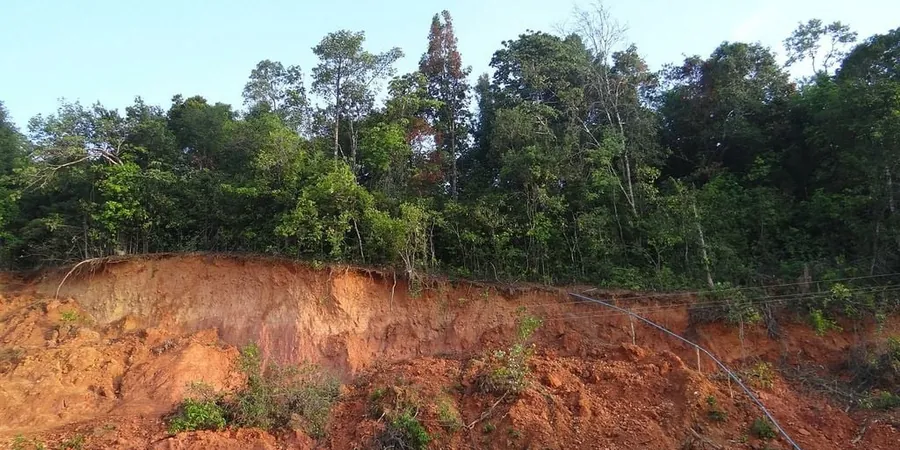
In Charlotte's Piedmont geology, the failure plane often hides in the transition zone between residual clay and weathered bedrock — a surface standard inspections miss.
Scope of work
- Detailed topographic and geologic mapping of the slope
- Boreholes and test pits to log soil and rock units
- Laboratory triaxial and direct shear tests on undisturbed samples
- Inclinometer monitoring for active movement
- Factor of safety calculation for static and seismic conditions
Area-specific notes
The most dangerous assumption in Charlotte is that the slope is stable because it looks dry on the surface. After heavy rainfall — typical during hurricane season from June to October — pore pressures rise quickly in the clay-rich residual soils, reducing effective stress and triggering failures that move slowly at first but accelerate without warning. We use inclinometers and piezometers installed in boreholes to track real-time movement and water levels, giving clients data to act before a slide reaches structures or utility lines. A proper landslide assessment in Charlotte identifies these risks early, saving owners from emergency repairs that easily run five figures.
Standards used
IBC 2021 (International Building Code, Chapter 18), ASCE 7-22 (Minimum Design Loads, Section 11.8 – Seismic Slope Stability), ASTM D1586-18 (Standard Test Method for SPT), ASTM D4767-20 (Consolidated Undrained Triaxial Compression Test), FHWA-NHI-05-089 (Geotechnical Engineering Circular No. 7 – Slope Stability)
Linked services
Slope Stability Analysis
Limit-equilibrium and finite-element modeling using software like Slide2 and PLAXIS. We compute factors of safety for circular and non-circular failure surfaces, considering seismic loads per ASCE 7-22 and groundwater conditions from field monitoring.
Inclinometer Monitoring
Installation of inclinometer casings in boreholes to track lateral displacement over time. We take baseline readings and schedule monthly or event-triggered surveys to detect movement as early as 1 mm per month, typical of slow-moving landslides in Charlotte's residual soils.
Mitigation Design & Recommendations
Based on the assessment, we design practical solutions: subsurface drainage systems, soil nailing, retaining walls, or slope regrading. Our recommendations include construction specifications and cost estimates so clients can budget accurately.
Typical parameters
Top questions
What triggers landslides in Charlotte's Piedmont geology?
Most landslides in Charlotte are triggered by prolonged or intense rainfall that saturates the residual clay layer. The clay sits on top of less permeable weathered bedrock, creating a perched water table that reduces shear strength. Construction cuts, improper drainage, and seismic events can also initiate movement. Our assessments identify the specific trigger and recommend drainage improvements or structural stabilization.
How much does a landslide assessment cost in Charlotte?
A standard landslide assessment in Charlotte ranges between US$1,190 and US$3,250, depending on slope height, site access, and number of boreholes or inclinometers required. The price includes field work, laboratory testing, modeling, and a detailed report with factor of safety calculations and mitigation options. We provide a fixed quote after a site visit.
Do I need a landslide assessment before building near a slope in Charlotte?
Yes, if the planned structure is within 50 feet of a slope steeper than 3H:1V, or if the site has a history of slides. Charlotte's zoning ordinance and IBC 2021 require geotechnical evaluation for slopes exceeding 15 feet in height. Even if not mandated, the assessment protects your investment and can reduce insurance premiums for hillside properties.