Charlotte sits on the Piedmont geologic province, where residual soils from granite and gneiss weathering dominate the subsurface. These clay-rich profiles, often with shallow bedrock at depths of 3 to 8 meters, present specific challenges for liquid containment. When designing a landfill cap, stormwater pond liner, or secondary containment berm, the geomembrane specification must account for the local soil reactivity, drainage conditions, and the potential for differential settlement over the saprolite layer. We start every project with a site-specific soil evaluation and a review of the subgrade preparation requirements before selecting the polymer type, thickness, and scanning method. This ensures the geomembrane specification aligns with both the regulatory framework and the actual ground conditions found in Charlotte.
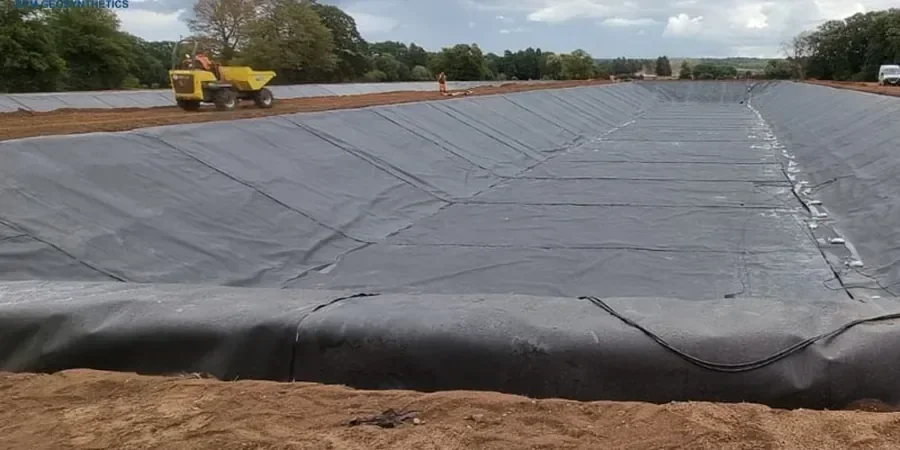
The geomembrane specification must account for local soil reactivity, drainage conditions, and differential settlement over the Piedmont saprolite layer.
Scope of work
- Subgrade compaction verification to 95% Standard Proctor density per ASTM D698
- Hydraulic conductivity testing of the foundation soil using a permeability field test to confirm drainage characteristics
- Differential settlement analysis using plate load testing on prepared subgrades
Area-specific notes
A geomembrane that fails in Charlotte's wet winter months is a costly mess. The Piedmont clay holds moisture, and a heavy downpour during installation can turn the subgrade into a slurry, trapping water under the liner. That water then softens the foundation, and the geomembrane stretches unevenly. We've seen 40-mil HDPE liners develop stress cracks within one season when installed over unprepared soil. To avoid this, we run a full subgrade moisture content analysis and require a minimum of 48 hours of drying weather before liner deployment. We also coordinate with the contractor to install temporary drainage berms and sump pumps. This is not theoretical — it's the difference between a 20-year warranty and a failed containment system in Charlotte.
Standards used
ASTM D5199 (thickness measurement), GRI-GM13 (HDPE geomembrane standard), ASTM D6392 (seam strength), ASTM D4218 (carbon black content), ASTM D698 (subgrade compaction)
Linked services
Subgrade Evaluation & Soil Testing
We perform compaction testing, permeability, and plate load tests on the prepared subgrade. Results are used to adjust the geomembrane specification and confirm the foundation is ready for liner placement.
Geomembrane Selection & Documentation
We prepare a technical specification sheet with polymer type, thickness, seam requirements, and quality assurance (CQA) plan. The document is tailored to Charlotte's soil conditions and local building codes.
Typical parameters
Top questions
What is the typical cost range for a geomembrane specification in Charlotte?
The cost for a complete geomembrane specification package, including subgrade evaluation and material selection, ranges from US$690 to US$1,590 depending on site size and complexity. This excludes liner installation and third-party CQA testing.
How does Charlotte's Piedmont soil affect geomembrane selection?
Piedmont residual clays are highly plastic and can shrink or swell with moisture changes. This means the geomembrane must be flexible enough to accommodate minor differential movements. We typically specify a textured HDPE liner with a minimum thickness of 1.5 mm to improve interface friction and reduce stress concentration.
What standards do you follow for geomembrane specification?
We follow ASTM D5199 for thickness, GRI-GM13 for HDPE properties, and ASTM D6392 for seam strength. For subgrade evaluation, we use ASTM D698 for compaction and ASTM D5084 for permeability. All specifications reference the current year of each standard.
Can you write a specification for an existing pond liner in Charlotte?
Yes. We can evaluate an existing liner by reviewing its installation records, performing visual inspections, and conducting seam strength tests on exposed edges. Based on that data, we will write a specification for repair or replacement that fits Charlotte's regulatory requirements.
Do you include a quality assurance plan in the specification?
Yes. The specification includes a CQA (Construction Quality Assurance) plan covering subgrade acceptance criteria, liner deployment procedures, seam testing frequency, and documentation requirements. The plan is written to meet both the project's design life and Charlotte's local environmental regulations.