Ground improvement in Charlotte encompasses a suite of geotechnical techniques designed to enhance the engineering properties of soil and rock for construction. The region's rapid urbanization, driven by finance, technology, and manufacturing sectors, demands reliable foundations for high-rises, infrastructure, and industrial facilities. Without proper ground treatment, problematic soils can lead to excessive settlement, slope instability, or bearing capacity failure, jeopardizing structures and public safety. This category integrates site investigation, design, and execution methods that transform weak or compressible ground into competent bearing strata, ensuring long-term performance and compliance with building codes.
Charlotte lies within the Piedmont physiographic province, characterized by residual soils derived from weathered igneous and metamorphic bedrock. These silty sands and sandy silts, often classified as ML or SM under the Unified Soil Classification System, exhibit variable thickness and can contain zones of partially weathered rock. A key challenge is the presence of unsaturated soils in cut slopes and compacted fills, where matric suction influences shear strength and volume change. Unsaturated soil analysis becomes critical for predicting slope behavior during heavy rainfall events, which are common in the region's humid subtropical climate.
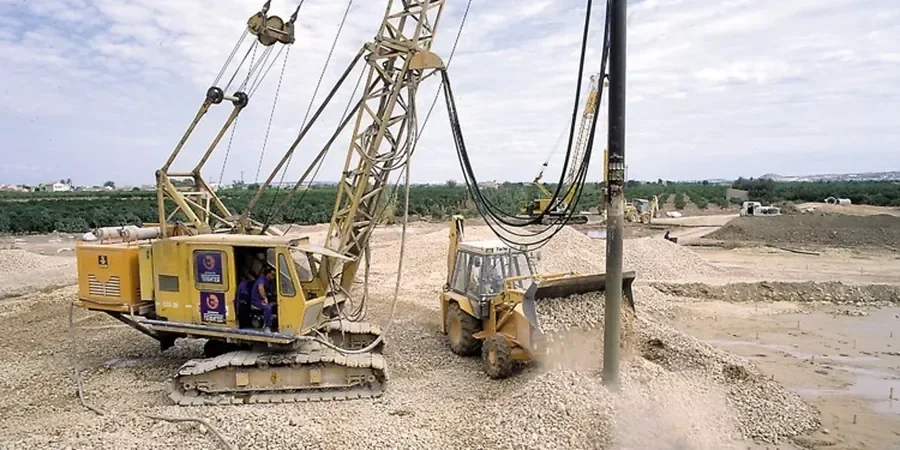
Geotechnical design in Charlotte must adhere to the North Carolina State Building Code, which references the International Building Code (IBC) and ASCE 7 for minimum design loads. The North Carolina Department of Transportation (NCDOT) Standard Specifications for Roads and Structures provide additional guidance for public works, particularly regarding embankment construction and ground treatment. Deep foundation and improvement designs typically require a geotechnical investigation per NCDOT or local municipality standards, with a minimum number of borings based on structure footprint. These regulations ensure that methods like deep mixing or stone columns meet performance criteria for settlement and bearing capacity.
Projects ranging from highway widenings along I-77 to mixed-use developments in South End frequently require ground improvement due to soft alluvial deposits in stream valleys or loose fill from historical development. For sites underlain by thick compressible clays, prefabricated vertical drain (PVD) design accelerates consolidation under preloading, reducing post-construction settlement. Where rapid strength gain is needed, deep soil mixing (DSM) design creates soil-cement columns that act as reinforcement elements. For large-area stabilization of expansive or collapsible soils, lime and cement stabilization modifies soil chemistry to reduce plasticity and improve workability. Each solution is selected based on subsurface conditions, loading requirements, and construction constraints.
Available services
Unsaturated soil analysis
→ Ver detalleStone column design
→ Ver detalleDeep Soil Mixing (DSM) design
→ Ver detallePrefabricated vertical drain (PVD) design
→ Ver detalleGrouting design
→ Ver detallePreloading design (without surcharge)
→ Ver detalleGeomembrane specification
→ Ver detalleLime and cement stabilization
→ Ver detalleLandfill geotechnics
→ Ver detalleContaminated soil remediation
→ Ver detalleCommon questions
What is ground improvement and when is it needed in Charlotte?
Ground improvement refers to techniques that enhance soil strength, stiffness, and permeability to support construction loads. In Charlotte, it is often required when soft residual soils, loose fill, or high groundwater compromise foundation performance. Projects like mid-rise buildings, bridge approaches, and retaining walls frequently rely on these methods to control settlement and ensure stability.
How do local soil conditions in Charlotte influence the choice of improvement method?
Charlotte's Piedmont residual soils are typically silty sands that can be unsaturated, collapsible, or highly variable in depth to bedrock. This variability demands careful site characterization. Methods like stone columns suit soft zones, while chemical stabilization addresses expansive clays. Unsaturated soil mechanics often govern slope design, requiring specialized analysis to account for seasonal moisture changes.
What regulations govern ground improvement design in North Carolina?
The North Carolina State Building Code adopts IBC and ASCE 7 standards, while NCDOT specifications apply to transportation projects. Geotechnical reports must follow local requirements for boring density and lab testing. Improvement designs typically require proof testing, such as load tests or post-treatment CPT soundings, to verify that performance criteria for bearing capacity and settlement are met.
What are the typical project types in Charlotte that require ground improvement?
Common projects include high-rise foundations over residual soil, warehouse slabs on compressible fill, road embankments crossing creek valleys, and stormwater detention basins. Each scenario demands a tailored approach—ranging from preloading with drains for soft clays to grouting for karst features in limestone bedrock, though karst is less prevalent here than in other parts of the state.