Our lab in Charlotte runs falling head and constant head permeability tests using flexible-wall permeameters and rigid-wall compaction-mold permeameters depending on soil type. For fine-grained Piedmont clays and silts we use the falling head method, while clean sands and gravels from the Catawba River basin go through the constant head procedure. Both setups are checked against ASTM D2434 and we record hydraulic conductivity values from 1×10⁻⁸ cm/s up to 1 cm/s. Before starting the test we always verify saturation levels with back-pressure, because partial saturation skews results. The permeameter cell is connected to a graduated burette and a constant-level reservoir; data logging captures readings every 30 seconds for the first 10 minutes then at longer intervals until steady flow is reached. This method gives us repeatable k-values that feed directly into seepage analysis and drainage design for Charlotte projects.
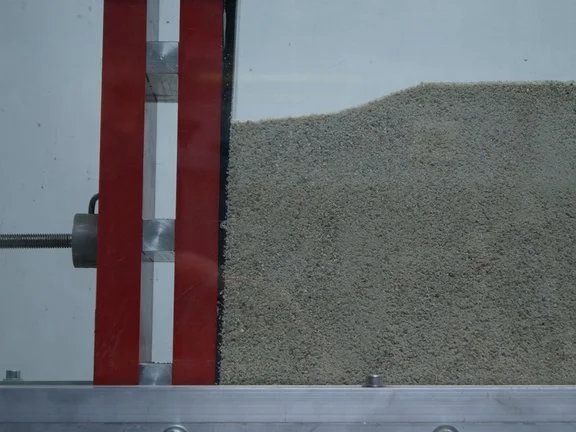
For Charlotte residual soils, one borehole may show k = 10⁻⁵ cm/s while another 50 feet away returns 10⁻⁷ cm/s.
Scope of work
Area-specific notes
A common mistake we see in Charlotte is relying on published literature values for Piedmont saprolite instead of running actual laboratory permeability tests. One firm designed a detention pond assuming k = 10⁻⁴ cm/s based on regional studies, but the site had micaceous schist with k = 10⁻⁶ cm/s. The pond never drained properly and required a costly retrofit with underdrains. When you skip the lab test you gamble on seepage rates that control everything from retaining wall drainage to foundation subgrade preparation.
Watch how it works
Standards used
ASTM D2434-19 (Constant Head Permeability of Granular Soils), ASTM D5084-16a (Falling Head Permeability of Fine-Grained Soils), AASHTO T 215-14 (Permeability of Granular Soils)
Linked services
Falling Head Test (Fine Soils)
For silts, clays, and saprolite. Uses flexible-wall permeameter with back-pressure saturation. Reports k at 3 effective stress levels. Turnaround: 7-10 business days.
Constant Head Test (Granular Soils)
For sands and gravels. Rigid-wall compaction-mold setup. Three hydraulic gradient runs per specimen. Turnaround: 5-7 business days.
Permeability Suite (Combined)
Falling head on fine layers plus constant head on coarse layers from same borehole. Includes gradation and void ratio correlation. Turnaround: 10-12 business days.
Typical parameters
Top questions
How much does a laboratory permeability test cost in Charlotte?
Our standard falling head or constant head test runs between US$460 and US$540 per specimen. The final price depends on specimen count, required confining pressures, and whether you need rush service (3-day turnaround available at a surcharge). We provide a detailed quote after reviewing the project scope and number of soil layers.
What is the difference between falling head and constant head permeability tests?
Falling head is used for fine-grained soils (clays, silts) where flow rates are low — water level drops gradually in a standpipe, and k is calculated from the rate of fall. Constant head is for granular soils (sands, gravels) where flow is steady — a constant water level is maintained and k is computed from the volume collected over time. ASTM D2434 covers constant head; ASTM D5084 covers falling head.
Why should I run a lab permeability test instead of using published values for Charlotte soils?
Published values for Piedmont residual soils have a wide range (10⁻⁴ to 10⁻⁷ cm/s) that depends on mineralogy, weathering degree, and fracture density. Lab testing on your specific samples gives you site-specific k-values that directly impact drainage design, slope stability analysis, and foundation drainage. Without it you risk over- or under-designing your seepage control systems.